NIMP logo
  • Log In
  • Sign Up
  • NIMP Analytics

NIMP: Neuroanatomy-anchored Information Management Platform for Collaborative BICAN Data Generation (RRID:SCR_024684)

NIMP is developed under NIH BRAIN Initiative's BICAN U24MH130988 award as a part of the coordinating unit for biostatistics, informatics, and engagement (CUBIE) for the BRAIN Initiative Cell Atlas Network (BICAN) program.

NIMP consists of two portals for BICAN collaborative data generation: the Specimen Portal and the Sequence Library (SeqLib) Portal. The Specimen Portal focuses on tissue management from donors to brain slabs and annotated brain samples. The SeqLib Portal manages the workflow starting from tissue, all the way downstream to track data deposition to assay-dependent, data-modality-specific archives. Both portals work in tandem to generate multimodal genomic data that can be traced back to their anatomical origins using the Allen Brain Atlas.

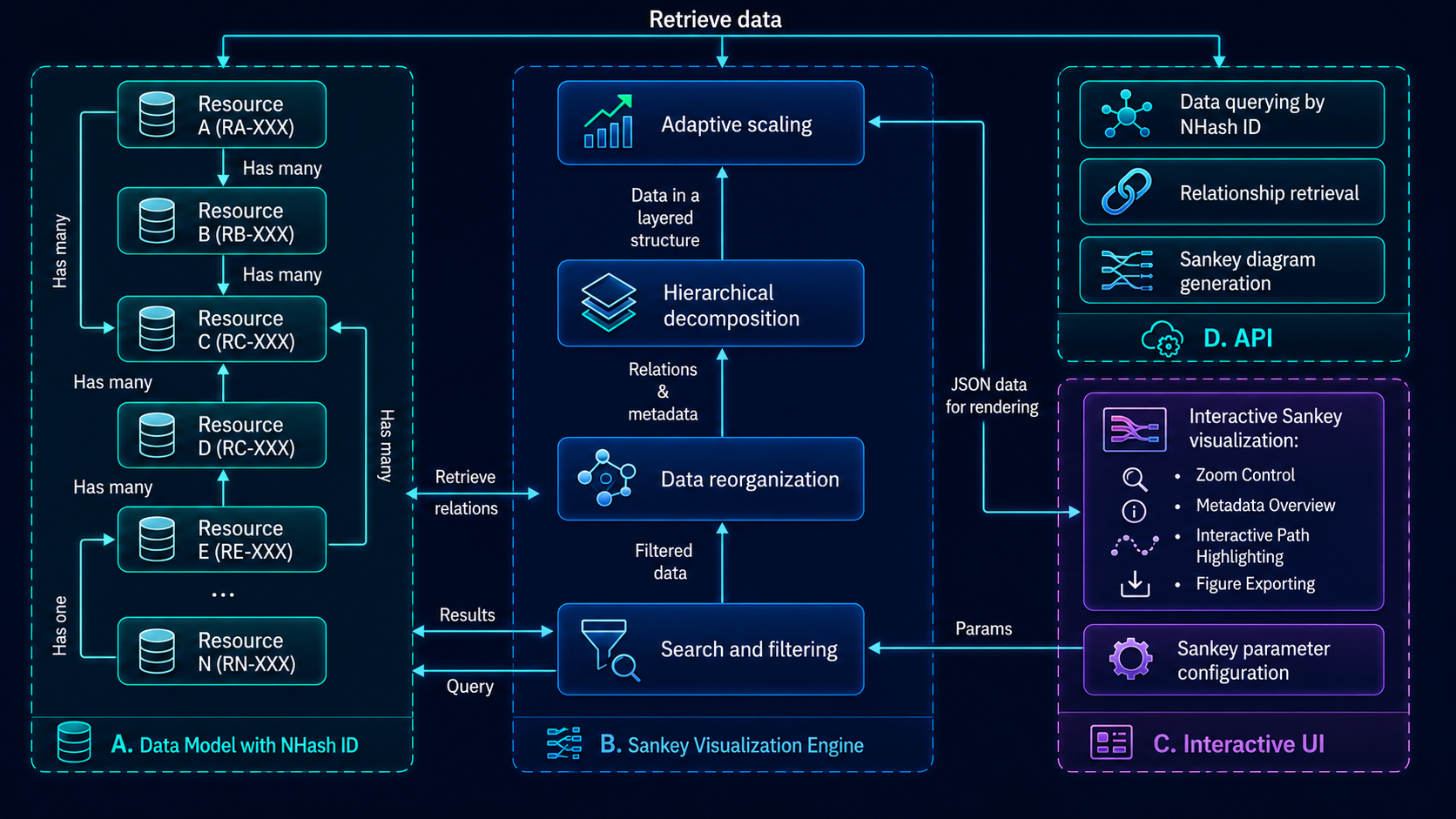
The portals provide multiple types of data interfaces through dashboards, APIs, faceted queries, and batch data ingestion and exporting. All of the underlying functionalities are achieved through a robust agile development strategy using NHash resource identifiers, metadata standardization, active combinatorial dashboarding, resource provenance linkage and rendering (e.g. Sankey diagrams), and dedicated interfaces with NIH Neuro Biobank, sequencing centers, NeMO, and the larger BICAN data ecosystem.

Sign Up Log In NIMP Analytics FAQ Architectural Diagrams Publications Cite

Frequently Asked Questions

Please click the “Sign-up” button on the top-right of the landing page to start the sign-up process.

To request a specific user role such as Brain Bank Personnel or Library Submitter, you need to indicate this in the "Message" text box on the sign-up page. If you have already signed up, please email Shiqiang Tao ([email protected]) what user role you need.

Contact the user who is the manager of the Lab in the portal to have you added to the Lab.

The User Guide contain a glossary of terms describing the meanings of the terms used in the portal.

Yes, the portal has an API for data access. More information can be found in the Swagger page and the User Guide.

Yes, the Resource Browser in NIMP allows you to explore all unrestricted data available in NIMP through an interactive interface.

Refer the User Guide for detailed information. If you still have questions, email Rashmie Abeysinghe ([email protected])

More

Architectural Diagrams

Data Ecosystem Upstream Components (Blue Diagram)

The upstream BICAN data ecosystem workflow diagram shows how Specimen Portal facilitates data transfer across different ecosystem components.
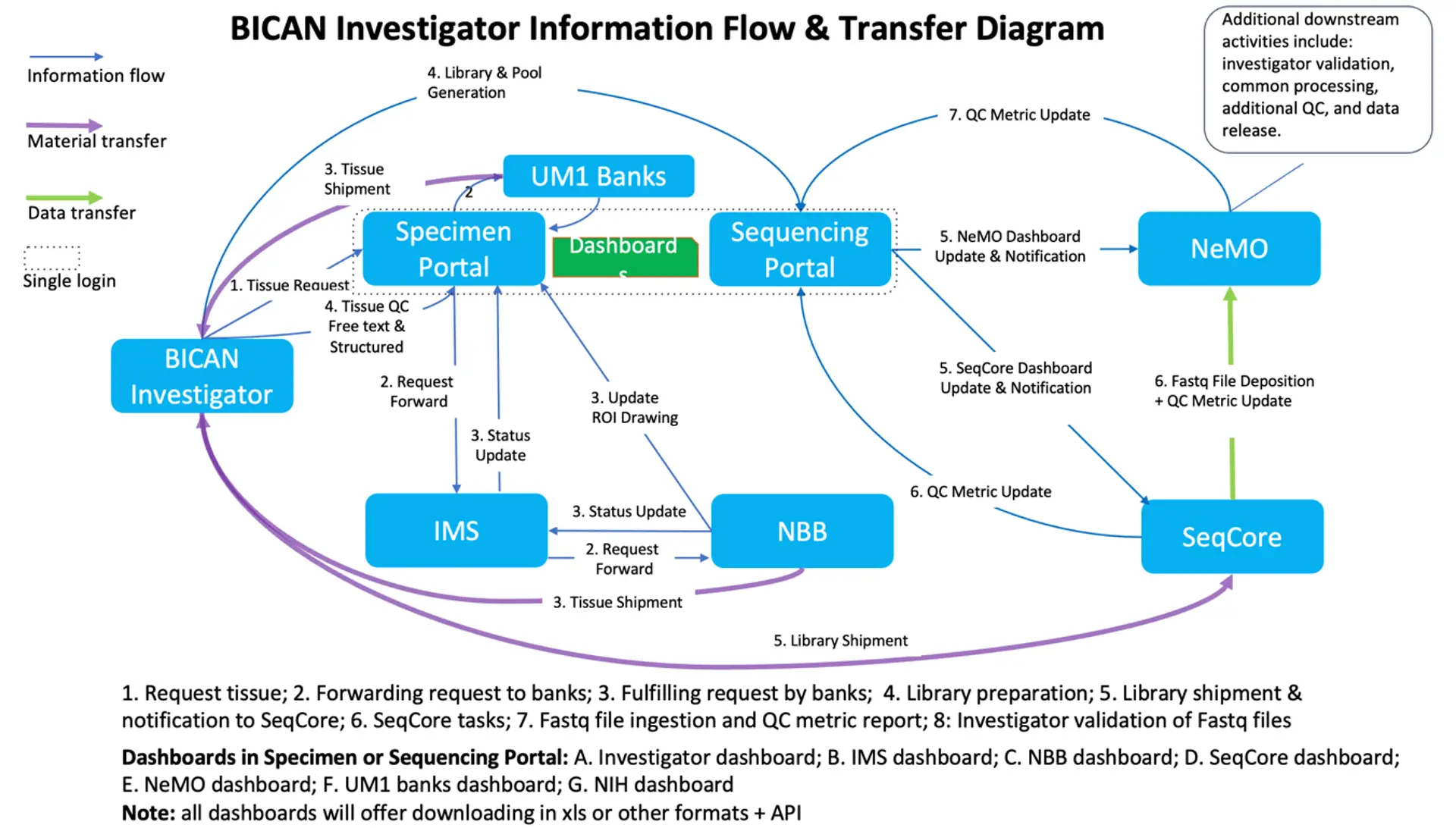
Blue Diagram

Sequencing Library Workflow (Purple Diagram)

The sequencing library workflow diagram shows the detailed dataflow from Specimen Portal to Sequencing Portal, then to Seq Core and NeMO.
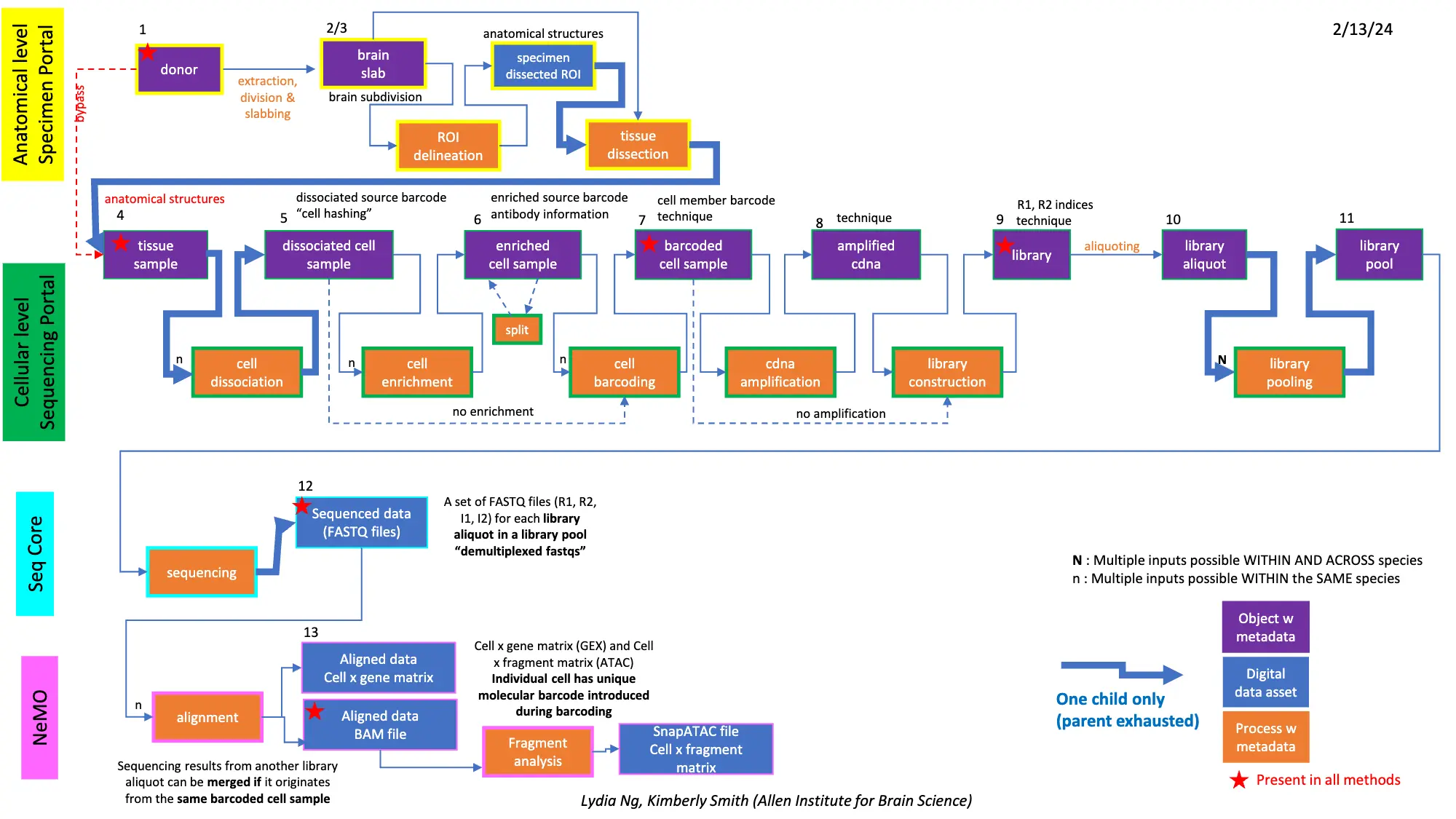
Purple Diagram

Resource Provenance Tracking (Sankey Diagram)

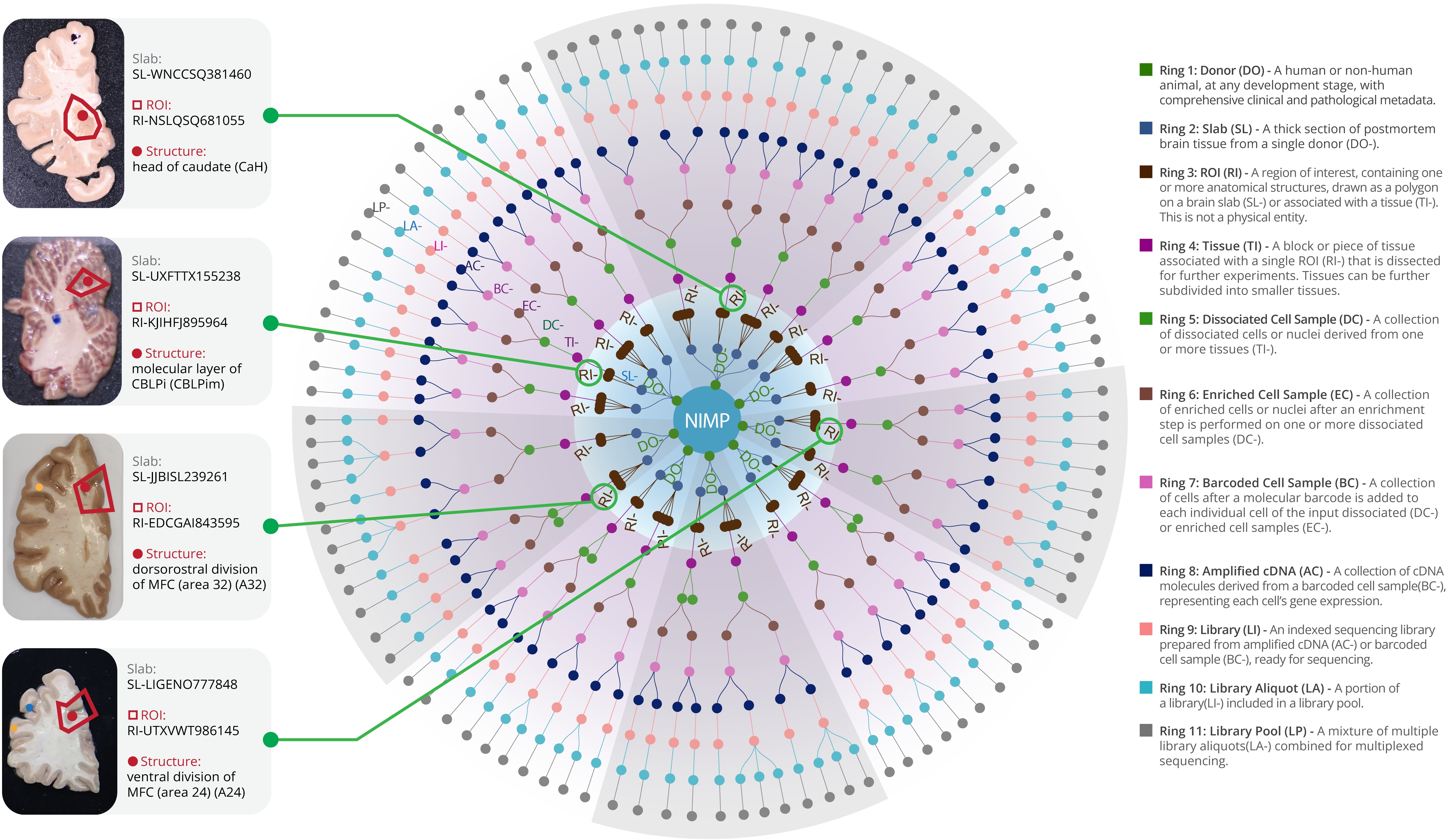
The BICAN resource-provenance visualization engine uses NHash identifier to identify, link, and track BICAN resource items from their source-point inception all the way to output data files. It uses the Sankey rendering library to visualize flow from donor ancestors to library aliquot descendants, through tissue region of interests (ROIs) as the intermediary, from any ancestor to any descendant and vice versa. It provides seamless linkage from resources in the Specimen Portal to those in the Sequencing Library Portal, whereby integrates the functional components of NIMP.
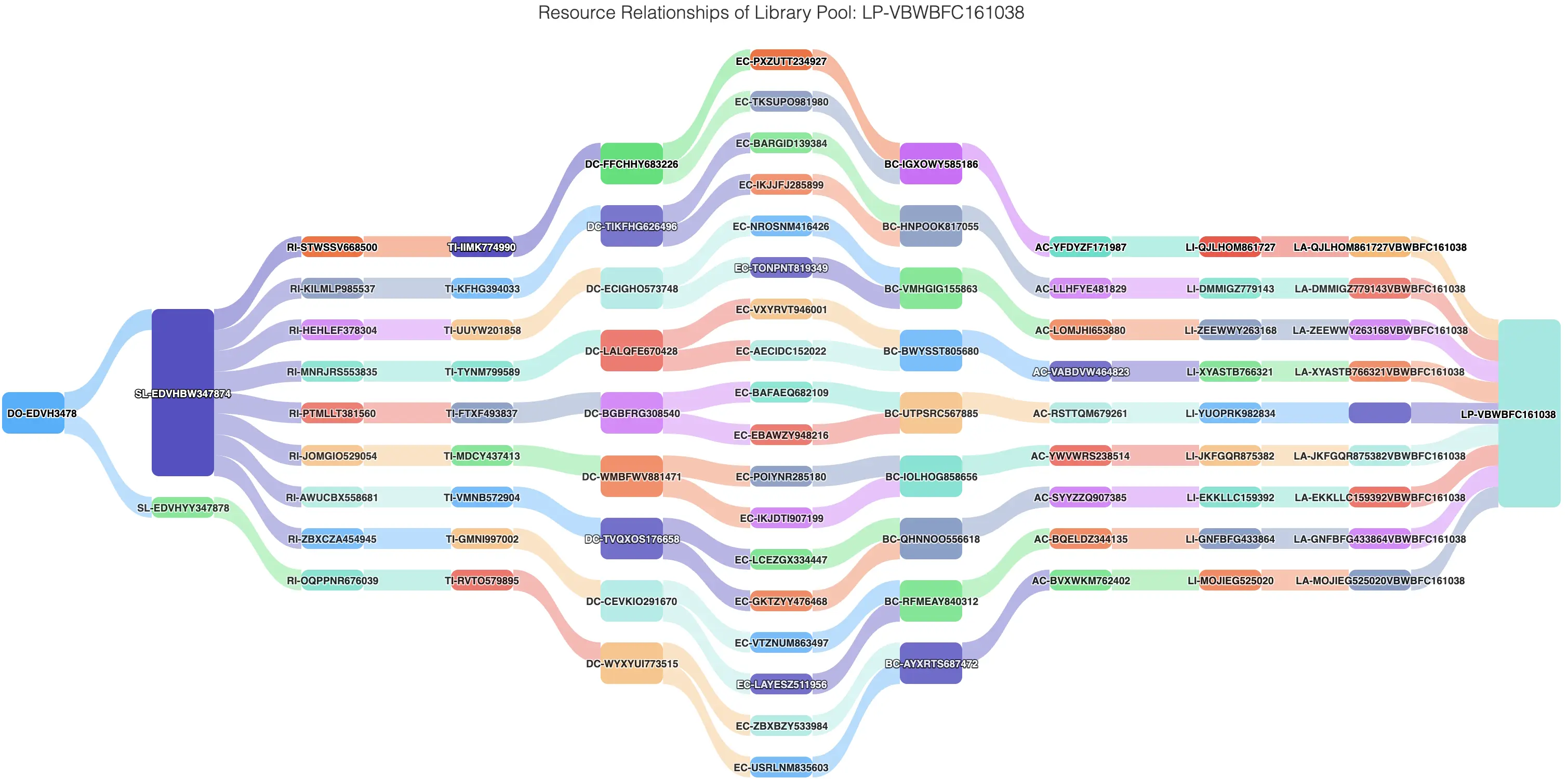
Sankey Diagram

API Specification

The NIMP API suite, following the RESTful structure, allows users and systems to lookup various structured data, slab images, and annotations with API lookup calls. All BICAN resource types with NHash identifiers can be looked-up and retrieved using APIs, including, but not limited to: donor, slab, ROI, library, library pool, library aliquot, as well as all data elements (variable names) used in the implementation of NIMP (and mapped to other standardized codes and terms).
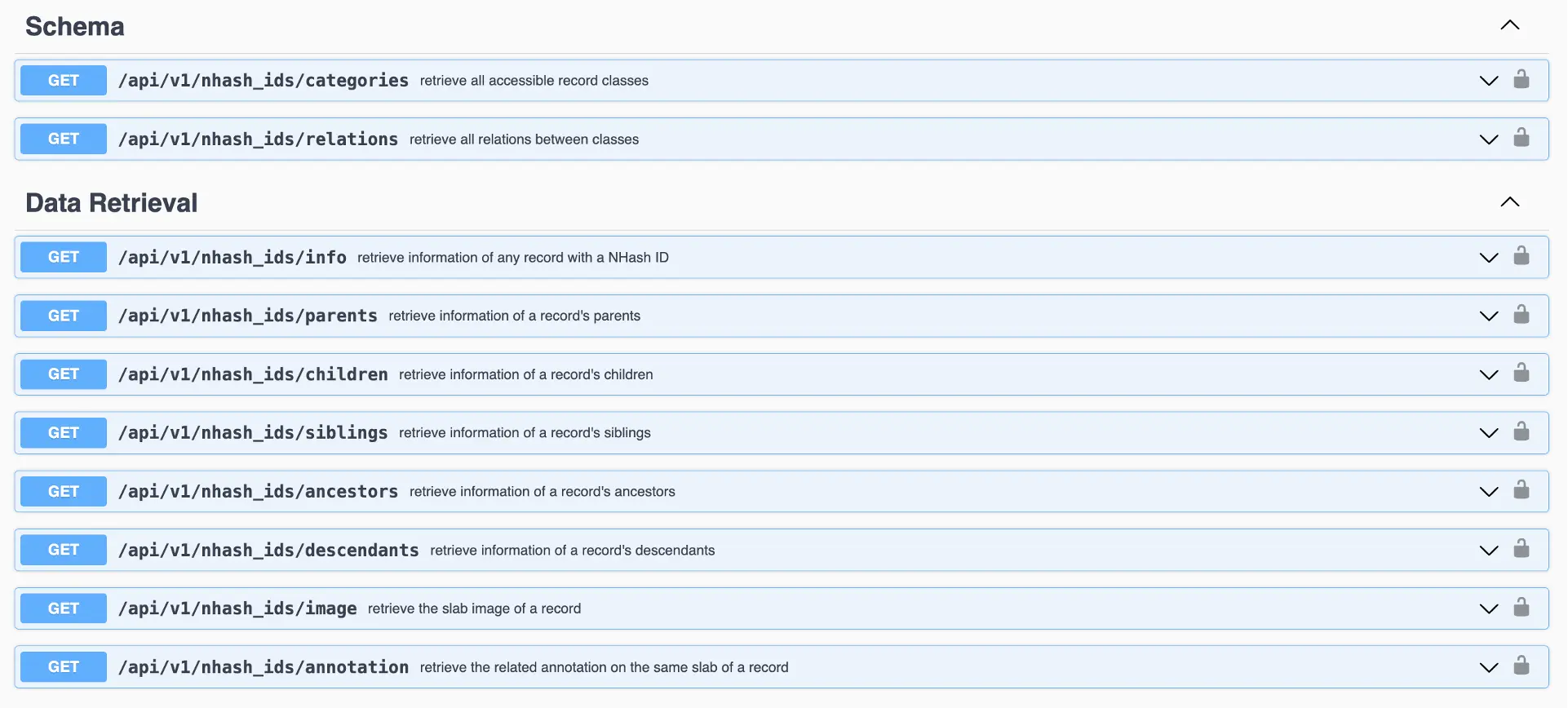
API Specs image
API Documentation
Data Ecosystem Upstream Components (Blue Diagram)
Blue Diagram
Sequencing Library Workflow (Purple Diagram)
Purple Diagram
Resource Provenance Tracking (Sankey Diagram)
Sankey Diagram
API Specification
API Specs image

Publications

Publications
2025

Tissue-to-Bytes: A Catalytic Digital Twin Platform for Consortium-Scale Integration of Single-Cell Omics Data Across the BRAIN Initiative Cell Atlas Network

Authors

Shiqiang Tao, Xiaojin Li, Yan Huang, Rashmie Abeysinghe, Ling Tong, Shiwei Lin, Wei-Chun Chou, Erge Edgu-Fry, Kimberly A Smith, Lydia Ng, Licong Cui, Guo-Qiang Zhang

Tissue-to-Bytes: A Catalytic Digital Twin Platform for Consortium-Scale Integration of Single-Cell Omics Data Across the BRAIN Initiative Cell Atlas Network poster
Abstract

The NIH BRAIN Initiative Cell Atlas Network (BICAN) is a collaborative effort among neuroscientists, computational biologists, and data scientists to create reference brain cell atlases to be used by the research community as a molecular and anatomical foundational framework for the study of human brain function and disorders. Coordinated sharing and management of the scarce human brain tissue, across lifespans and among the eleven participating BICAN centers and laboratories with anatomical precision, is a formidable undertaking. Creating and operating the necessary data production pipelines with de novo metadata standards prospectively established to adhere to the highest possible levels of Findable, Accessible, Interoperable, and Reusable (FAIR) data principles, present unparalleled challenges that place BICAN into uncharted territories. A digital twin paradigm has been formulated and operationalized to manage advanced single-cell molecular techniques and complexity of data production workflows that are used in the BICAN consortium. The Neuroanatomy-anchored Information Management Platform (NIMP) implements the digital twin paradigm from conception to design, to production. NIMP is an agile, extensible, catalytic infrastructure for integrative and collaborative BICAN consortium-scale FAIR data generation. Digital-twin thinking ensures that NIMP provides tissue-to-bytes, end-to-end integration of data production pipelines spanning brain banks, laboratories, sequencing centers, and data archives. NIMP's digital twin characteristics are manifested in the coupling of real-world workflows occurring in the BICAN laboratories with their digital counterparts moving progressively through verifiable provenance lineage paths. The implementation of NIMP's digital twin features are grounded on advanced informatics strategies that include codification of anatomical contexts; standardized tissue request and sharing workflows, library preparation, sequencing, and single-cell omics data generation and deposition. These workflows and processes are governed by standardized Common Data Elements (CDEs); tracked by blockchain-inspired resource-identifiers (ID); ingested and edited using role-based access control (RBAC); and accessed by query-embedded dashboarding and atlas-enabled interactive resource exploration with dynamically rendered Sankey diagrams. In three years, NIMP has managed data and metadata for 762 human donors, 8,449 brain slabs, and 21,781 sequencing libraries across 11 laboratories, resulting in an estimated total of over 18 million cells for Basal Ganglia alone. The NIMP digital twin paradigm not only serves BICAN; it provides a blueprint for future-proof data coordination at consortium scale.

Public Link
Publications
AMIA 2026

BRIDGE: Binding Research Assets and Their Inscriptions in a Data-Ecosystem Digital Twin Using CDE-based Bidirectional Feedback: Results from the NIH BRAIN Initiative Cell Atlas Network

Authors

Rashmie Abeysinghe, Ph.D.; Yan Huang, Ph.D.; Ling Tong, Ph.D.; Shiwei Lin, M.S.; Wei-Chun Chou, M.S.; Kimberly A. Smith, B.S.; Shiqiang Tao, Ph.D.; Licong Cui, Ph.D.; Xiaojin Li, Ph.D.; Guo-Qiang Zhang, Ph.D.

BRIDGE: Binding Research Assets and Their Inscriptions in a Data-Ecosystem Digital Twin Using CDE-based Bidirectional Feedback: Results from the NIH BRAIN Initiative Cell Atlas Network poster
Abstract

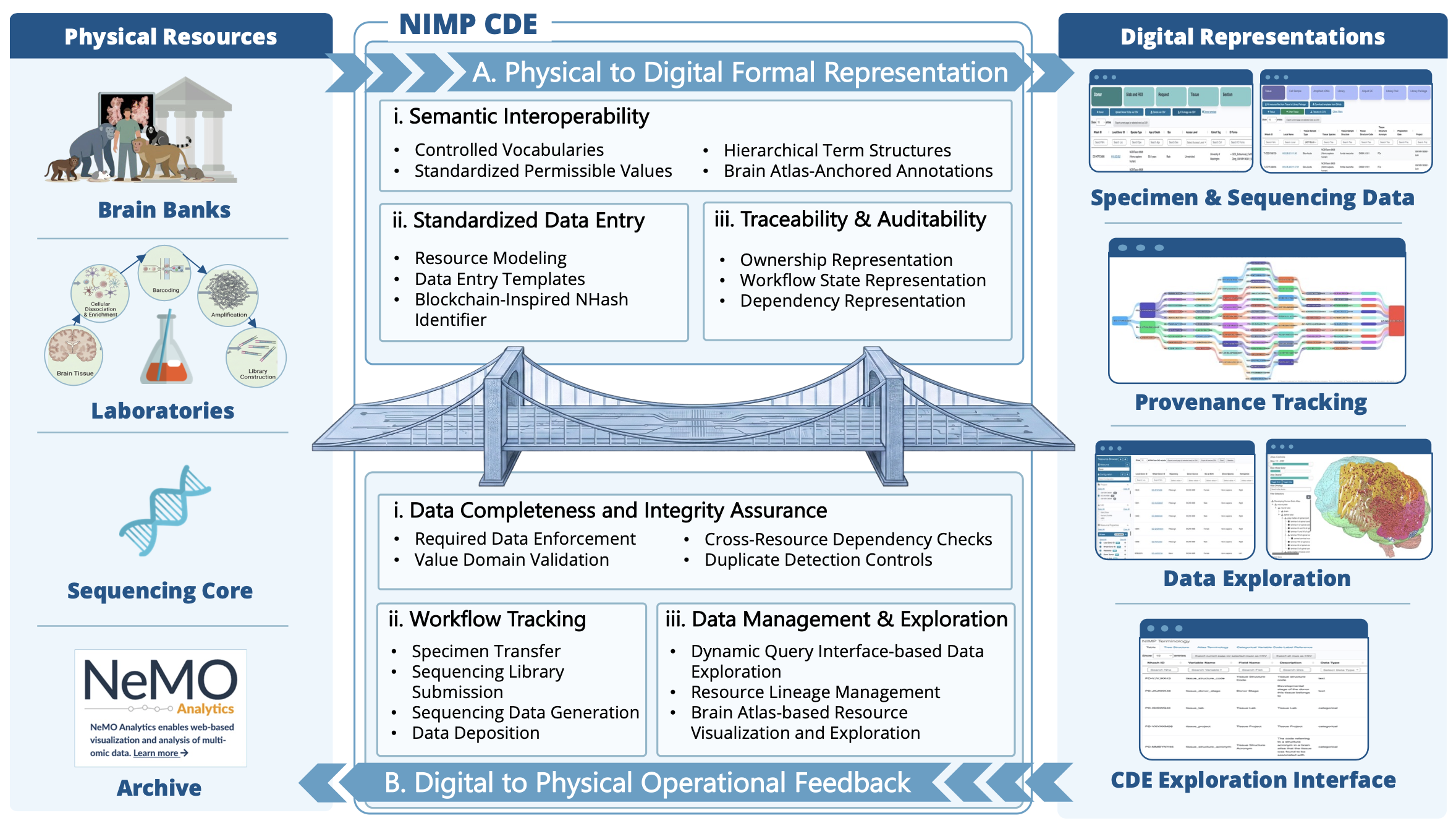
The NIH BRAIN Initiative Cell Atlas Network requires rigorous coordination for sharing limited human brain tissues, multi-stage experimental workflows, and multimodal sequencing data. To address this complexity, the Neuroanatomy Anchored Information Management Platform (NIMP) was developed as a consortium-scale data ecosystem that operationalizes a digital twin paradigm. Within NIMP, we propose BRIDGE, a Common Data Element (CDE)-based framework that binds physical research assets to their structured digital inscriptions through bidirectional feedback mechanisms. CDEs formalize resource attributes, workflow states, validation constraints, and provenance relationships from donor registration through sequencing data generation. In total, 452 CDEs (171 numeric, 155 categorical, 111 text, and 15 date) constitute the specification underlying 26 standardized data entry templates. BRIDGE further provides resource-specific, role-based dashboards and integrated exploration interfaces to support workflow tracking, querying, and controlled data export. NIMP supports 17 NIH awards and 234 daily users, managing over 195,000 records and demonstrating sustained consortium-scale coordination.

Public link pending
Publications
IEEE ICHI 2026

BRAVE: Neuroanatomy-anchored Brain Region Annotation, Visualization, and Exploration Engine for BRAIN Initiative Cell Atlas Network

Authors

Xiaojin Li; Yan Huang; Wei-Chun Chou; Ling Tong; Shiwei Lin; Rashmie Abeysinghe; Licong Cui; Shiqiang Tao; Guo-Qiang Zhang.

BRAVE: Neuroanatomy-anchored Brain Region Annotation, Visualization, and Exploration Engine for BRAIN Initiative Cell Atlas Network poster
Abstract

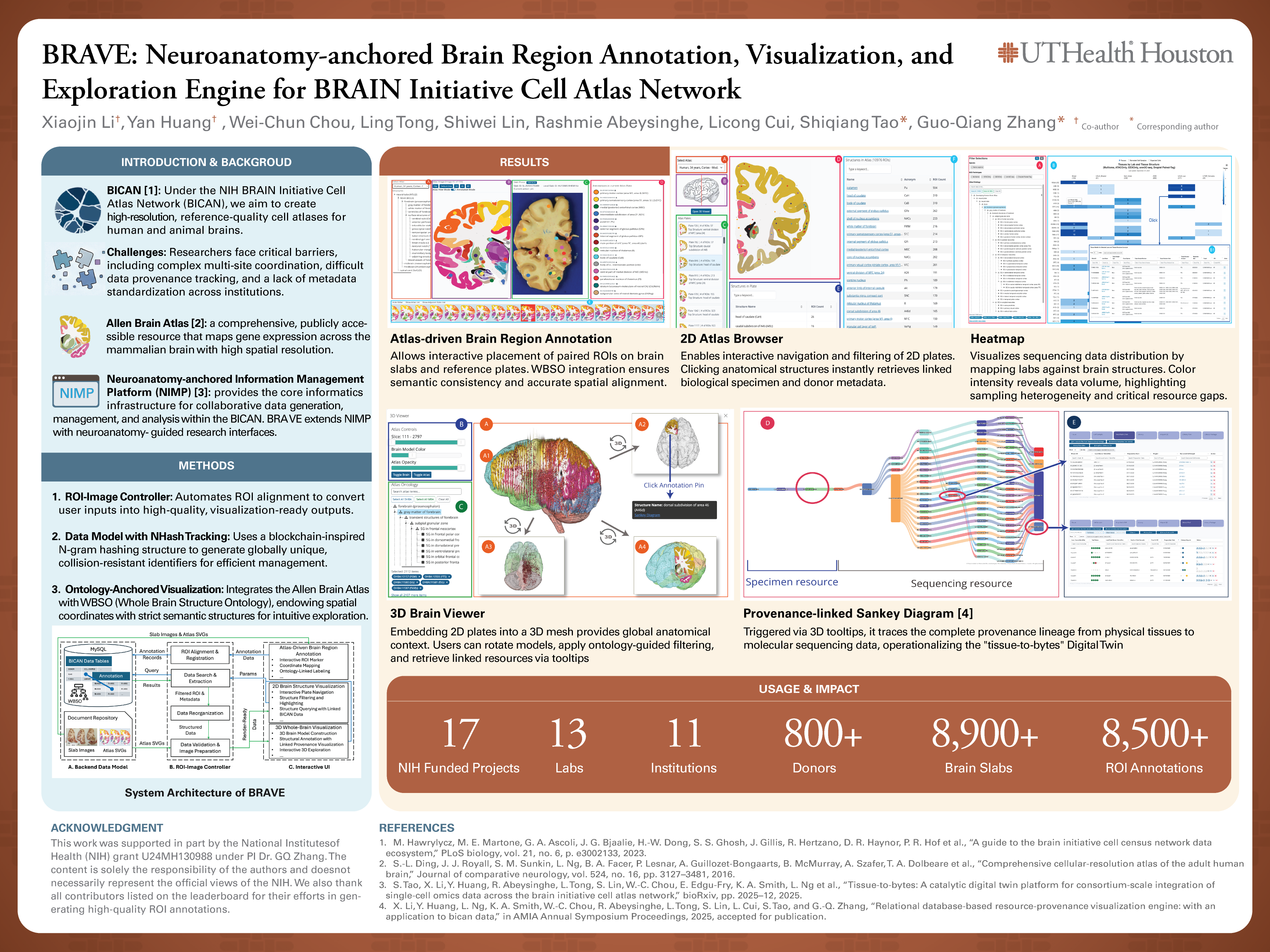
The goal of the NIH BRAIN Initiative Cell Atlas Network’s (BICAN) is to create a comprehensive cell census and atlas of the human brain to accelerate progress in neuroscience and translational medicine. This goal requires not only large- scale genomic and imaging data generation but also accurate spatial alignment of brain specimens to a common coordinate framework. To address this need, we present BRAVE, a web-based Neuroanatomy-anchored Brain Region Annotation, Visualization, and Exploration engine for BICAN. BRAVE enables interactive annotation of brain specimens using the Allen Brain Atlas, links data to the Whole Brain Spatial Ontology, and provides 2D and 3D visualization of annotated regions. Its visualization capabilities allow researchers to explore complex spatial relationships, examine the anatomical distribution of generated datasets, and access associated data across the entire brain. By combining ontology-driven annotation with interactive visualization, BRAVE supports reproducible, scalable mapping of BICAN data, facilitates integrative analyses and cross-study comparisons, and advances the standardization and accessibility of large-scale neuroscience datasets.

Public link pending
Publications
AMIA 2025

Unified Resource Browser: An Interactive and Reconfigurable Web Framework for Biomedical Metadata Exploration, Visualization, and Management

Authors

Shiwei Lin; Ling Tong; Kimberly A. Smith; Lydia Ng; Tyler Mollenkopf; Yan Huang; Rashmie Abeysinghe; Wei-Chun Chou; Antarr T. Byrd; Licong Cui; Guo-Qiang Zhang; Xiaojin Li; Shiqiang Tao.

Unified Resource Browser: An Interactive and Reconfigurable Web Framework for Biomedical Metadata Exploration, Visualization, and Management poster
Abstract

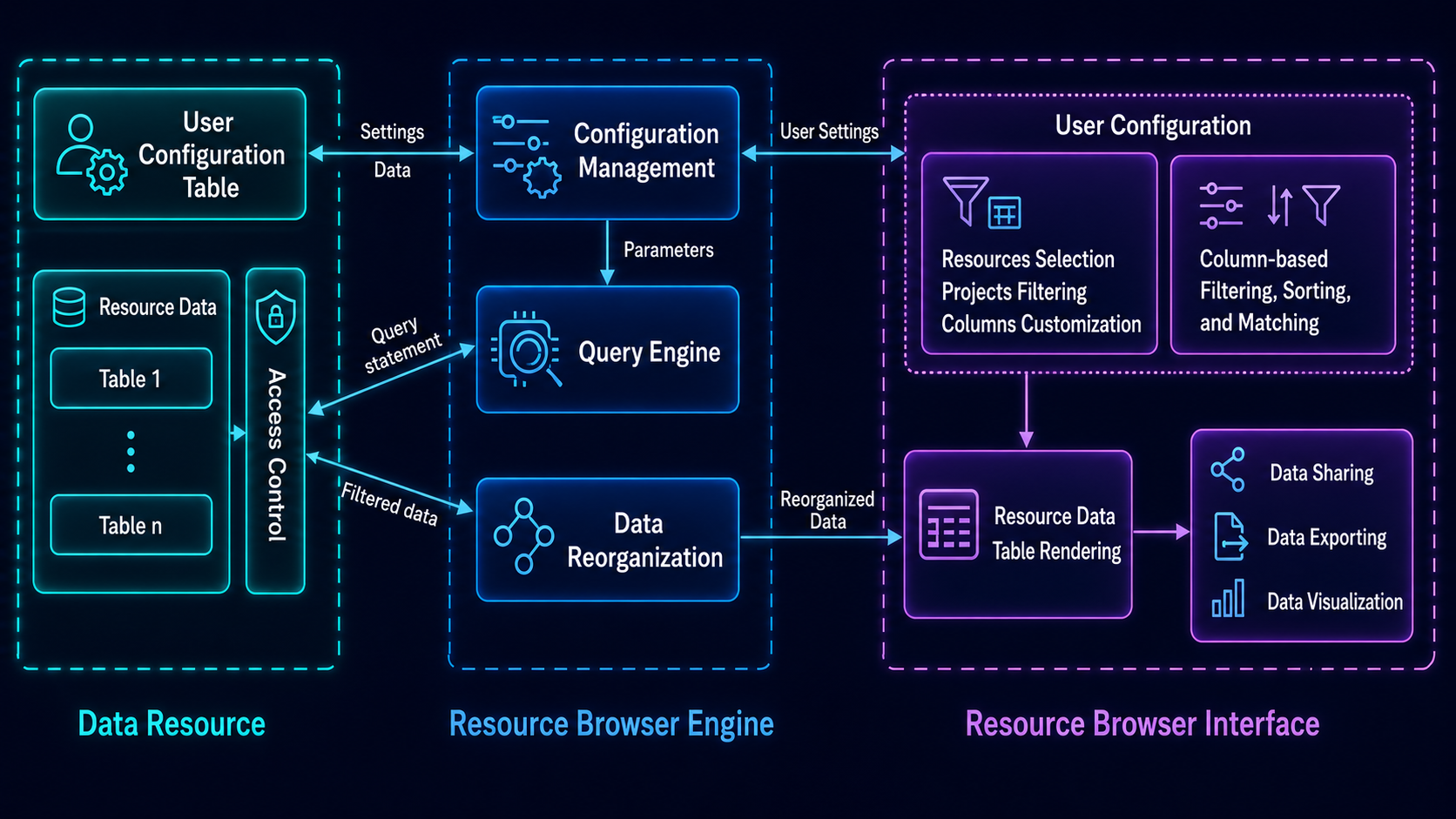
We present Unified Resource Browser, a web-based framework designed to optimize the configuration, exploration, visualization, and dissemination of complex biomedical metadata. As a core component of Neuroanatomy-Anchored Information Management Platform (NIMP), Unified Resource Browser enables researchers to efficiently access donor information, brain tissue samples, and sequencing data through structured resource tables and advanced search and filtering capabilities. The platform allows users to customize data views, share configurations via direct links, and seamlessly export data for further analysis. Integrated visualization tools offer immediate insights through customizable charts, enhancing data interpretation. By improving the accessibility and usability of biomedical data resources, Unified Resource Browser fosters collaborative research and advances discoveries in brain structure and function.

Public Link
Publications
AMIA 2025

Relational Database-Based Resource-Provenance Visualization Engine: with an application to BICAN data

Authors

Xiaojin Li; Yan Huang; Lydia Ng; Kimberly A. Smith; Wei-Chun Chou; Rashmie Abeysinghe; Ling Tong; Shiwei Lin; Licong Cui; Shiqiang Tao; Guo-Qiang Zhang.

Relational Database-Based Resource-Provenance Visualization Engine: with an application to BICAN data poster
Abstract

Provenance tracking ensures data integrity, security, and accountability in healthcare and biomedical research. As biomedical data grows in complexity, comprehensive tracking mechanisms are needed to maintain reproducibility, transparency, and compliance with regulatory standards, such as GDPR. Traditional log-based and ontology-based approaches capture and standardize data lineage, while cryptographic and blockchain-based methods enhance security and verifiability. However, challenges remain in scalability, security, and usability. To address these, we introduce the Resource-Provenance Visualization Engine (RPVE), an advanced system integrating data lineage tracking and interactive visualization. RPVE employs the Randomized N-gram Hashing Identifier (NHash ID) to establish precise data links within the BRAIN Initiative Cell Atlas Network (BICAN) and features an interactive Sankey visualization engine for seamless data exploration. The system enhances provenance tracking by improving data retrieval efficiency, ensuring reliable verification processes, and maintaining data integrity.

Public Link
Cite NIMP
Copy
UTHealth Houston © 2022-2026